
Product details
Made possible by exploring innovative molded plywood techniques, Iskos-Berlin’s Soft Edge Chair blends strong curves with extreme lightness to create a three-dimensionality not usually possible with 2-D plywood.
Description
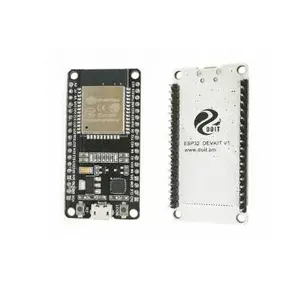
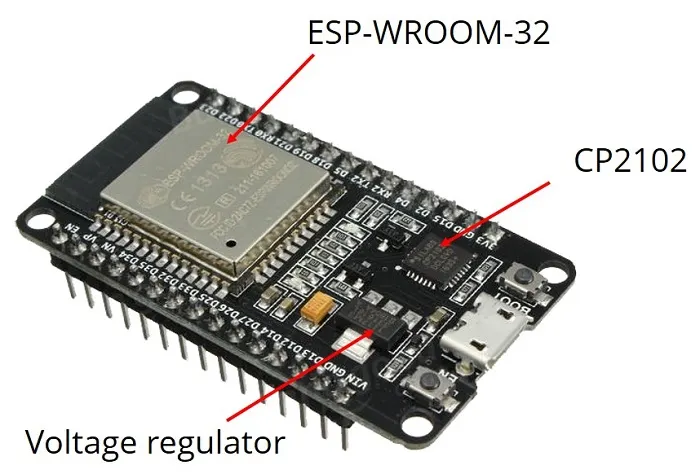
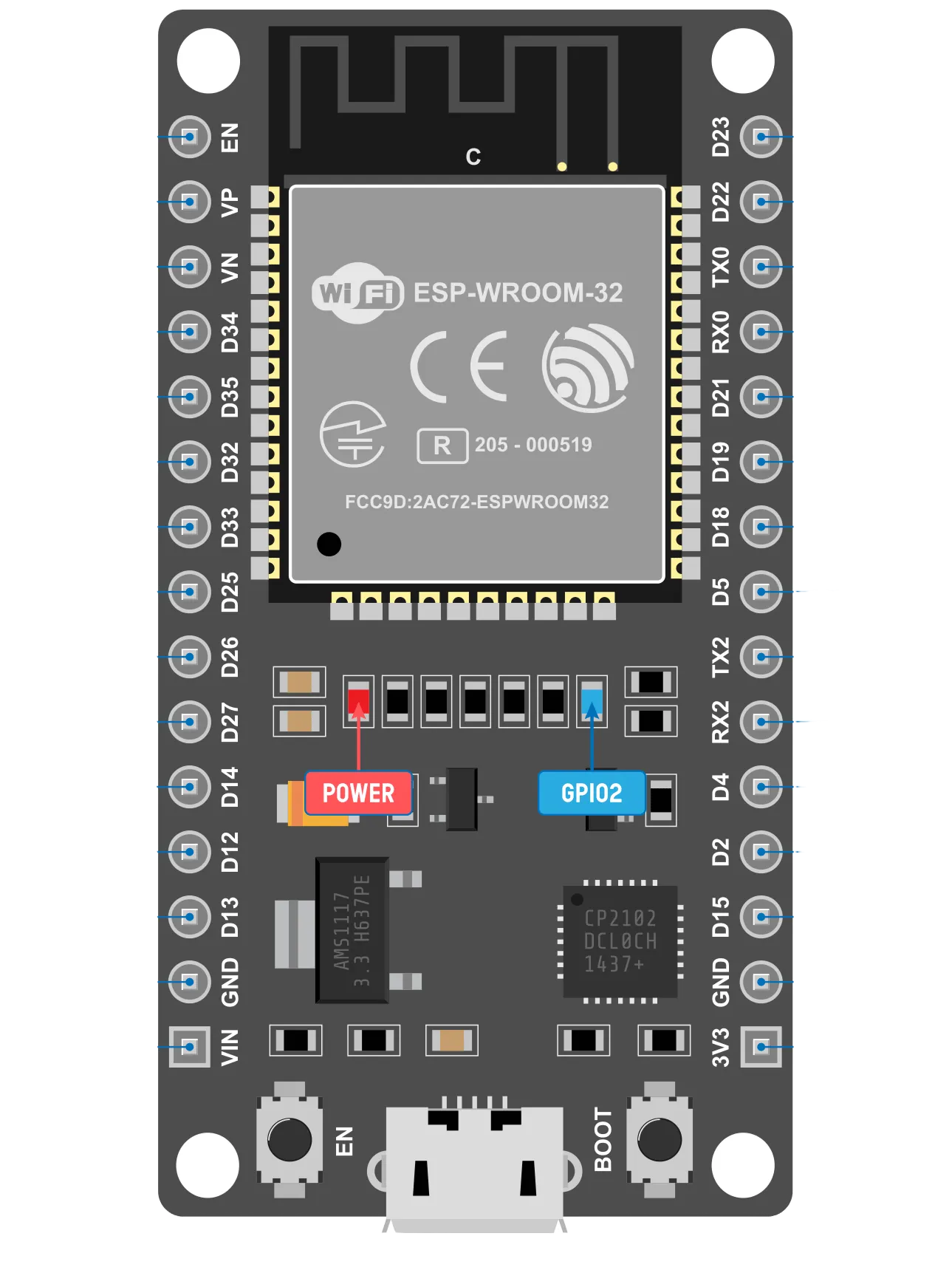
Description of ESP32 DEVKIT V1
The ESP32 Devkit V1 by [Espressif Systems](https://www.espressif.com/) is the world’s smallest microcontroller series which comes with integrated WiFi and Bluetooth capabilities that make it suitable for [IoT projects](https://randomnerdtutorials.com/projects-esp32/) and compact electronic devices.
The ESP32 Devkit V1 outperforms both [Arduino](https://www.arduino.cc/) and [Atmel](https://www.microchip.com/en-us/about/corporate-overview/acquisitions/atmel) and [PIC](https://www.microchip.com/en-us/products/microcontrollers/8-bit-mcus/pic-mcus) because it provides more pins and a quicker processor and better functionality. Some people use the [Raspberry Pi](https://www.raspberrypi.com/) to compare with the ESP32 but the ESP32 is better because it costs less and takes up less space and uses less energy and works better for tiny applications.
Specification :
|
Parameter |
Details |
|---|---|
|
Microcontroller |
ESP-WROOM-32 |
|
Processor |
Xtensa dual-core 32-bit LX6 |
|
Clock Speed |
240 MHz |
|
RAM |
520 KB SRAM, 448 KB ROM, 16 KB SRAM in RTC |
|
Flash Memory |
4 MB |
|
WiFi |
802.11b/g/n |
|
Bluetooth |
V4.2 |
|
GPIOs |
25 |
|
Antenna |
On-board PCB antenna |
|
Programming Port |
Micro USB |
|
USB to UART |
CP2102 |
|
Dimensions |
50 × 29 mm (±2) |
Comparison With Other :
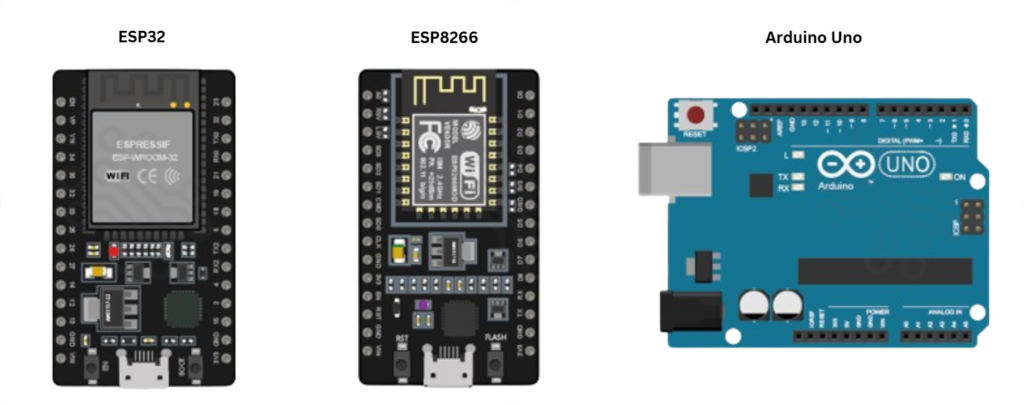
The ESP32 Devkit V1 provides a strong dual-core development board which includes Wi-Fi and Bluetooth connectivity together with multiple GPIO pins to support advanced Internet of Things applications. The ESP8266 NodeMCU V2 board provides basic Internet of Things functionality through its single-core Wi-Fi capability although it has fewer available pins than other devices. The Arduino UNO board provides entry-level users with a basic development platform which lacks wireless capability and operates at reduced speed while offering limited pin access to support fundamental electronics work and prototype development.
|
Feature |
ESP32 |
ESP8266 |
Arduino UNO |
|---|---|---|---|
|
Clock Speed |
240 MHz |
160 MHz |
16 MHz |
|
WiFi |
Yes |
Yes |
No |
|
Bluetooth |
Yes |
No |
No |
|
Memory |
520 KB SRAM, 4 MB Flash |
520 KB SRAM, 4 MB Flash |
520 KB SRAM, 4 MB Flash |
|
GPIOs |
25 |
17 |
20 |
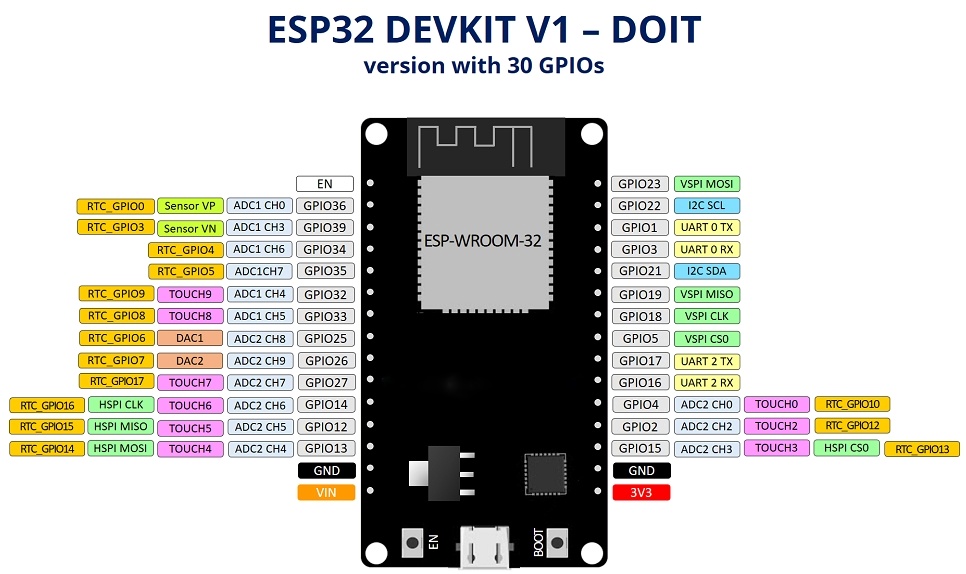
ESP32 Pin Diagram :
|
Pin |
GPIO |
Alternate Pin Function |
Safe |
Remarks |
|---|---|---|---|---|
|
1 |
EN / RESET |
|||
|
2 |
GPIO36 |
VP / ADC1_0 |
⚠️ |
Input only |
|
3 |
GPIO39 |
VN / ADC1_3 |
⚠️ |
Input only |
|
4 |
GPIO34 |
ADC1_6 |
⚠️ |
Input only |
|
5 |
GPIO35 |
ADC1_7 |
⚠️ |
Input only |
|
6 |
GPIO32 |
ADC1_4 / Touch9 |
✅ |
|
|
7 |
GPIO33 |
ADC1_5 / Touch8 |
✅ |
|
|
8 |
GPIO25 |
ADC2_8 / DAC1 |
✅ |
|
|
9 |
GPIO26 |
ADC2_9 / DAC2 |
✅ |
|
|
10 |
GPIO27 |
ADC2_7 / Touch7 |
✅ |
|
|
11 |
GPIO14 |
ADC2_6 / Touch6 / HSPI_CLK |
✅ |
|
|
12 |
GPIO12 |
ADC2_5 / Touch5 / HSPI_MISO |
⚠️ |
Must be LOW during boot |
|
13 |
GPIO13 |
ADC2_4 / Touch4 / HSPI_MOSI |
✅ |
|
|
14 |
GND |
— |
||
|
15 |
VIN |
— |
4.8V < VIN < 12V |
|
|
16 |
3.3V |
— |
600mA |
|
|
17 |
GND |
— |
||
|
18 |
GPIO15 |
ADC2_3 / Touch3 / HSPI_CS |
⚠️ |
Must be HIGH during boot, prevents startup log if pulled LOW |
|
19 |
GPIO2 |
ADC2_2 / Touch2 / CS |
⚠️ |
Must be LOW during boot and connected to onboard LED |
|
20 |
GPIO4 |
ADC2_0 / Touch0 |
✅ |
|
|
21 |
GPIO16 |
U2_RXD |
✅ |
|
|
22 |
GPIO17 |
U2_TXD |
✅ |
|
|
23 |
GPIO5 |
VSPI_CS |
⚠️ |
Must be HIGH during boot |
|
24 |
GPIO18 |
SCK |
✅ |
|
|
25 |
GPIO19 |
VSPI_MISO |
✅ |
|
|
26 |
GPIO21 |
SDA |
✅ |
|
|
27 |
GPIO22 |
SDA |
✅ |
|
|
28 |
GPIO23 |
VSPI_MOSI |
✅ |
|
|
29 |
TX0 |
UART0_TX |
⚠️ |
Used for programming |
|
30 |
RX0 |
UART0_RX |
⚠️ |
Used for programming |
- HSPI and VSPI both can be used for SPI interfaces, where VSPI pins are commonly used in standard libraries.
- All GPIOs except input-only GPIOs can function as PWM output.
- The system blocks ADC2 pin access during WiFi operation.
- All DACs have 8-bit resolution.
- The ESP32 supports two I2C buses which do not have fixed assignment because users can choose their pin configuration.(GPIO21 and GPIO22 are commonly used.)
- The hardware reset function disables the chip when you pull the EN pin to low state.
Reviews
Clear filtersThere are no reviews yet.